


Overview
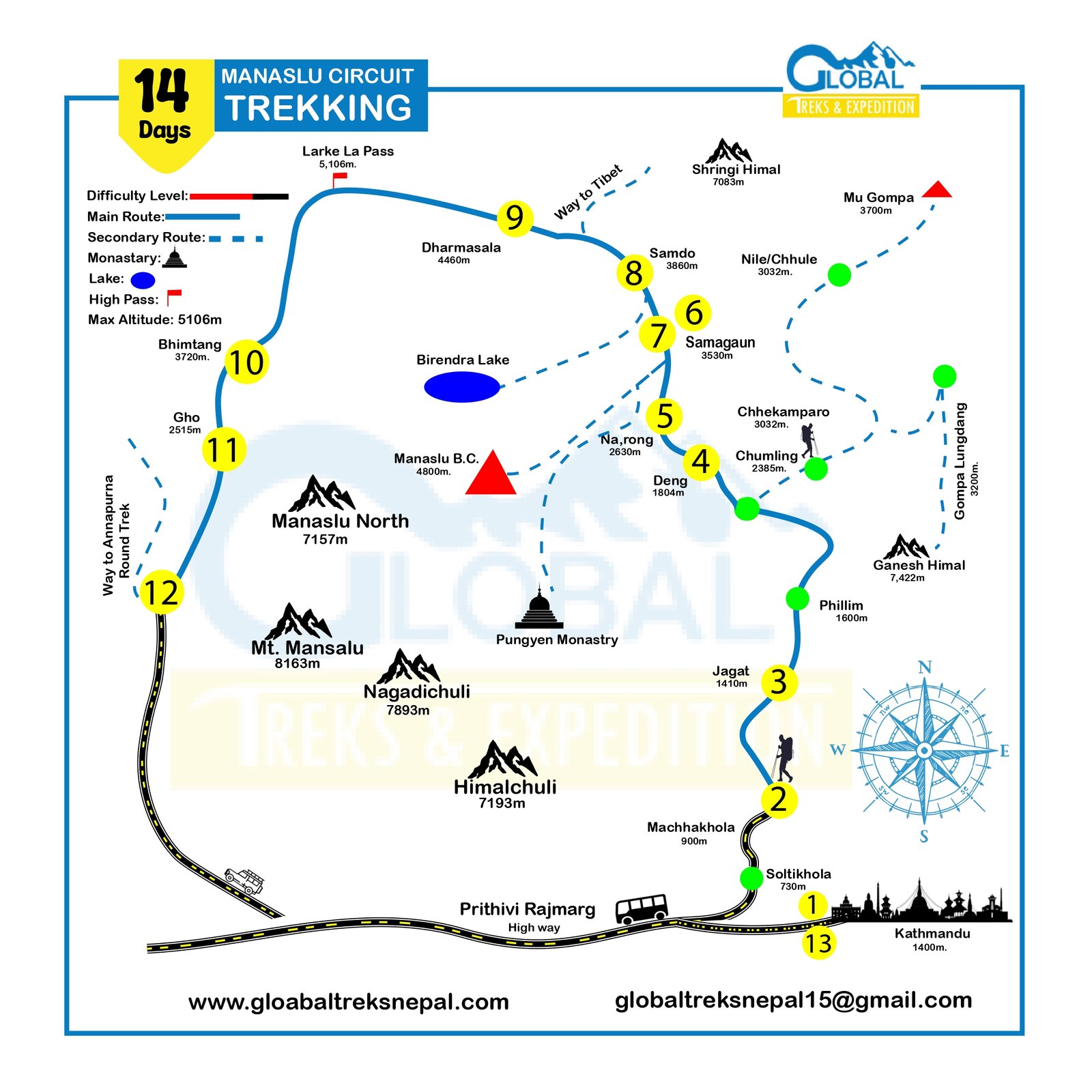
Our Manaslu Circuit via Larkya La Pass trek starts with an overland drive from Kathmandu. Our trekking starts from Arughat or Soti-Khola depending on vehicle availability and the condition of the road. Then walk follows the mountain villages of Gorkha District. We visit Jagat, Dying, Samagaon, and Samdo with grand views of Mt. Manaslu, Bouddha Himal, and Ganesh Himal in the east. And Annapurna Himalaya towards the west, reaching at Larkya-La pass at 5,214 M. The highest spot of the adventure. you can freely search by Manaslu trekking map.
Geographically spectacular
Manaslu Circuit Via Larkya La Pass trek is geographically spectacular and culturally fascinating. The inhabitants of the upper Buri Gandaki also known as Nupri. The western mountains are direct descendants of Tibetan immigrants entry the Gorkha District and exited the Lamjung District. On ABC Trekking Their speech, dress, and customs are almost exclusively Tibetan. Manaslu is the eighth tallest mountain in the world that captures the local heritage of the Himalayan region. There is still continuous trade between Nupri and Tibet; Chinese cigarettes, for example, are found more frequently than Nepali cigarettes. Also, include Annapurna Region Trekking ABC.
Challenge
The mountain views in Nupri are sensational and the crossing of the Larkya La is one of the most dramatic of any pass in the Himalayas. Because much of this trek is in a region of strong Tibetan influence, most places have Tibetan names in addition to their better know Nepali monikers. Manaslu Circuit via Larka la Pass Trek suits those who challenge with trekking in the mountain regions & we can find lots of tea houses where you can spend a good time.
Trip Outline
Day-01: Arrival to Kathmandu (1,350 M)
Day-02: Drive from Kathmandu to MachhaKhola (890 m) (157 Km - 9/10 hours)
Day 03: Trek from Machhakhola to Jagat (1,410 m) – (13.5 km - 7/8 hours)
Day 04: Trek from Jagat to Dyang (1,800 m) – (20 km - 7/8 hours)
Day 05: Trek from Dyang to Namrung (2660 m) – (19 km - 7/ 8 hours)
Day 06: Trek from Namrung village to Shyala (3,500 m) (18 km – 7/8) hours)
Day 07: Trek from Shyala to Samagaun via Pungyen Monastery (3585 m) (17 km - 6/7 hours)
Day 08: Acclimatization Day Hike to Manaslu Base Camp (4800 m) - (13.5 km - 5/6 hours)
Day 09: Trek from Samagaun to Samdo (3,860 m) – (5km - 4/5 hours)
Day 10: Trek to Dharmasala / Larkya La Phedi (4,460 m) – (6 km - 4/5 hours)
Day 11: Cross Larkya la 5,106 m and decent to Bhimthang (3,790 m) – (16 km - 8/9 hours)
Day 12: Trek from Bhimthang to Tilje village (2300 m) – 4 hrs - 13km) then drive to Besisahar - 3 Hrs
Day 13: Drive back to Kathmandu or Pokhara by local bus (1350 m/175km) – 7/8 hours
Day 14: International departure for homeward bound.
Detail itinerary
Breakfast Kathmandu Hotel
Our representative guide will meet you at the airport after that you will be taken to the hotel where you prefer to stay. Some hours will give you for the rest and then in the hotel, Guide will briefing about the activities and the equipment. Overnight in Kathmandu hotel.
9/10 hours B/L/D Lapbesi hotel
On the following day, you will leave Kathmandu about 6.30 am drive to Machha Khola via Dhading, Gorkha, Arughat Bazaar. This road journey offers you beautiful views of hills, rivers, and rural villages along the Budhi Gandaki River. The terrace which will come to appear to belong to Lapbesi. (local village) where you Stay overnight at lodge.
7/8 hours B/L/D Jagat Guesthouse
You cross the Machha Khola – Fish Stream – and head upstream to the tiny village of Khola Bensi and the hot springs at Tatopani. The valley sides are steeping until they are impassable and the route then switches to the left bank by way of a suspension bridge. The trail is quite exposed and challenging in places. After a short section of the forest path, you reach the single teahouse at Doban. Above Doban, the Buri Gandaki descends an impressive series of rapids. Beyond this steep section, the river is much more placid, meandering across a broad gravel bed. At Lauri, you re-cross the river on a suspension bridge, and then climb on a high path to the fields of Jagat, where you camp.
7/8 hours B/L/D Dyang Guesthouse
From Jagat, you will head to Film after taking breakfast. At first, you will take upward and downward movement. Then, the trail will again make you scale up where you will get to view the pleasant setting of nature. Taking downward movement passing the river you will ascend to Saguleri and from here you can capture the sight of Sringi Himal. For another time you will pass from Gata Khola viewing Ganesh Himal.
7/ 8 hours) B/L/D Namrung Guesthouse
Moving all through the Alpine area, adding the views of mountains with some mani walls will take you to Namrung. Before that, you will also pass the Budhi Gandaki and over the village, you can enjoy the beautiful village with extensive pastures.
7/8) hours B/L/D Shyala Guesthouse
From Namrung to the pretty village of Shyala (3,500 m), which offers incredible view of Mt. Manaslu and Himalchuli, you pass through cultural communities like Lihi and Lho. You'll see people going about their everyday lives in the mountains as you travel through stone villages and forests.
6/7 hours B/L/D Manaslu Guesthouse
The path then proceeds towards Samagaun (3,585 m) with a detour to the beautiful and peaceful Pungyen Monastery, where you can see how the glaciers sit in breathtaking, calmness and feeling the spiritual energy. The path reveals beautiful scenery, accompanied by occasional sightings of Himalayan fauna. Reaching the heart of Manaslu.
4/5 hrs B/L/D Samagaun Guesthouse
Day 8 is a rest day to help your body get used to the high altitude. You can take an easy hike to Manaslu Base Camp, which is a beautiful spot near the big mountain. This helps you feel stronger for the harder days ahead. You will spend the night again in Samagaun.
4/5 hours B/L/D Manaslu Base Camp guest house
you will trek towards Manaslu Glacier all through the forests occupied by birch, juniper, and rhododendron. You will ascend and stroll below a stone arch to Samdo. Samdo, the trekking trail divides to the Tibetan border.
4/5 hours B/L/D Larkya La Phedi Guesthouse
you will leave Samdo and head to trek Dharamsala where the level of difficulty will add. Covering higher altitude and viewing Larkya Glacier you will take upward all through the juniper forests. you will start the trek viewing Cho Danda and Larkya Peak. You will spend a night in Larkya la phedi.
8/9 hours B/L/D Bhimthang Guesthouse
As you cross the challenging Larkya La Pass (5,106 m), offering breathtaking views of Himlung Himal, Annapurna II, and Kang Guru. After conquering the pass, you descend to Bhimthang (3,790 m).
3 hrs B/L/D Besisahar hotel
will make you sense a trouble less trek. Again viewing remarkable panoramas of the astonishing peak you will continue the trek. The forest, the pasture land all will greet you and will take you to Gurung village which is known as Tilje. From Tilje, you’ll drive around 3 hours to Besisahar for the night.
7/8 hours B/L Kathmandu Hotel
Now drive back to Kathmandu or Pokhara. After finishing your trek, you’ll take a long but scenic ride through hills, rivers, and villages. You’ll finally reach the city where you can rest, relax, and enjoy a good meal after your big mountain adventure.
B
The trip concludes today. Our Airport Representative will drop you at the international airport in Kathmandu for your flight departure from Nepal carrying unforgettable memories of the Manaslu region.
What's included?
- Airport / Airport pick up & drop by private tourist vehicle.
- 2 N Kathmandu Hotel accommodation sharing bases with B/B( Bed & Breakfast)
- All your standard mentions Meals during the trek (B-Breakfasts, L-Lunches, D- Dinners).
- Lodges/Guesthouses accommodation during the 7 Days trek
- Local GLOBAL TREKS English speaking guide
- National Park permits and TIMS permit for trekking.
- Private transportation entire this trek. ( Kathmandu-Aarughat-Kathmandu)
- Food, accommodation, salary, insurance and medicine for all staff.
- All our government taxes, vat, tourist service charges
- Official expenses.
What's not included?
- Lunch /Dinner whilst in Kathmandu.
- Travel insurance which covers emergency Rescue and Evacuation.
- Alcoholic, hot and cold drinks.
- Personal trekking Equipment (See the trekking equipment page).
- Tips for trekking staff and driver (Tipping is expected).
- Any others expenses which are not mentioned on ‘Price Includes’ section.
Essential Information
The following gives you a general idea of the personal items that you can bring for the trek. The personal items as your individual interest, and choice. In a supported trek, heavy items are carried by porters or yaks and personal belongings that you may need for the day like money, camera, sun cream, water bottle, rain gear, and toilet paper etc. should be carried by yourself. So you are briefed to pack items in two different bags. The most important fact that one should keep on mind is that one should have enough clothes to tackle the cold weather in the mountain range.
(Note : We will supply complimentary water and wind proof duffel bag which you can use on the trek and is carried by porter/s. The duffel bag is yours to keep after the trek. You can leave your bag with your non-trek items at the hotel in Kathmandu and collect them after the trek)
Upper Body – Head / Ears / Eyes
Shade hat or baseball cap – of their head and then put a baseball cap on to hold it in place. This can be a flexible alternative while keeping the sun off your ears and neck.
Warm wool or synthetic hat that covers your ears.
Glacier glasses-100% UV protection with side shields and a hard-sided storage case (i.e. Julbo or Cebe). Regular sunglasses are not sufficient. If you wear prescription glasses, speak to your doctor about prescription glacier glasses, perhaps with transitional lenses. This is to protect your eyes from the rays of the sun due to the thinner atmosphere which can cause a painful condition known as snow blindness.
A neck warmer is another piece of gear for extra warmth if you feel you will need it .
Headlamp – Black Diamond and Petzl both make several good ones. Make sure to bring extra batteries and that they are lithium batteries so that they will last in the colder temperatures. These are indispensable for getting around at night, reading, etc.
Balaclava – lightweight, thinner variety
Some people like ear-muffs; these are optional; a good hat, balaclava, and hooded jacket should really be sufficient, but this is a personal choice for some people .
Hand
1 pair liner gloves, thin wool or synthetic, useful alone a days or as a layer inside other gloves / mitts for additional warmth.
1 pair warm gloves (heavier fleece or wool).
1 pair shell gloves or mitts; Gore-Tex is preferred for keeping hands dry.
Instant hand warmers are always nice in a pinch, but really shouldn’t be necessary on the trek. Bringing appropriate hand protection as recommended above, should be sufficient (optional).
Core Body
T-shirts (2/3
Light and expedition w)eight thermal tops.
Fleece jacket or pullover.
Fleece Wind-Stopper jacket (optional).
Waterproof (preferably breathable fabric) shell jacket.
2 women sports bras, Synthetic, no cotton!
Lower Body – Legs
2 pairs nylon hiking shorts – Quick drying type, not cotton!
Underwear, stay away from cotton .(4/5)
1 pair soft shell pants – synthetic, full zip from top and bottom preferable.
2 pairs trekking pants, the knees so they double as shorts.
1 pair hard shell pants. Waterproof / breathable, Gore-Tex or equivalent is best. Should zip from the top and bottom – this makes it easier to put on over boots without getting undressed should the weather change once you are underway for the day.
1 pair cotton pants (loose jeans/khakis).
2 pairs lightweight long underwear – capilene or other synthetic.
All clothing should be kept dry using waterproof stuff sacks or large puncture resistant plastic bags.
Feet
4/5 pairs of liner socks, synthetic or capilene.
3/4 pairs heavy weight socks to be worn over liner socks.
1 pair light weight socks, a good option for the lower / warmer parts of the treks.
1 pair light to medium weight water proof hiking/trekking boots.
1 pair light trekking shoes or sneakers. Good for around the camp/lodges and in Kathmandu.
1 pair hiking gaiters, good for keeping dust and rocks out of your shoes / boots as well as keep your feet dry as necessary (Optional).
1 pair sandals (Optional).
Medicines and First Aid Kits
(Please note WT guide will also carry the first aid kit bag during the trek. However we still recommend you to bring your personal first aid kit as well)
Extra Strength Excedrin for altitude related headaches.
Buprofen for general aches and pains.
Immodium or Pepto bismol capsules for upset stomach or diarrhea.
Diamox (commonly prescribed as Acetazolamide) 125 or 250mg tablets for altitude sickness. Please discuss with us before starting to take this medicine.
1 small personal sized first-aid kit with blister treatments such as mole skin, band-aids, some waterproof tape, anti-infection ointments, etc. your guides will have more extensive medical gear, but you should have the basics for general use.
Most Necessary Documents/Materials
Passport and extra passport photos (4 copies).
Airline ticket (Please make a copy and leave on at our office in KTM just in case if you need to change the date of your).
Durable wallet / pouch for travel documents, money & passport.
Lip balm. At least SPF 20, 2 sticks. A string taped to the stick is helpful, to hang around your neck and some are now being sold with a cord already attached. Handy as it avoids you from having to stop and look for it.
Sunscreen. SPF 40 is recommended and should be relatively new since it loses its’ effectiveness over time.
Pocket knife or small Swiss Army type.
Water purification Iodine tablets or Polar-pure crystals.
Toiletry kit. Be sure to include toilet paper stored in a plastic bag, hand wipes, and liquid hand sanitizer, towel, soap, etc.
2 bandanas.
Optional
1 pair adjustable trekking poles. Although these are listed as optional, these can be of great assistance to people who may think of themselves and generally clumsy or with bad knees, ankles, etc, especially when going downhill (Optional).
Binoculars (Optional).
Favorite snack foods, no more than 2 pounds (Optional).
Paperback books, cards, mp3 player (there are a couple of stops where you could recharge. Avoid players with moving hardware as it may not function. Remember, keep these items light weight) (Optional).
Hydration bladder with drinking tube and tube insulator (Optional).
A pee bottle for men and pee funnel for woman, some swear by them to avoid that chilly late night trip (Optional).
1 small stainless steel thermos (Optional).
1 light weight point & shoot camera or 1 large SLR. Digital cameras are ok, but you must keep the batteries warm when not in use (Optional).
Please Note: Tight fitting, figure-hugging clothing, such as those made with Lycra can often be offensive to locals, especially to women. If you find these items comfortable as a base layer, please pack something to wear on top of them.
Above This list is only a guide lines. While you are required to bring everything on this list, there are numerous options, brands, and versions of each piece of equipment. Please Use your experience and the listed features to find the best gear for you. Some of the above equipments can be easily found in stores in Kathmandu for cheaper prices.
Price Starts
US $1755
$ 1855
Group Discount Price
Number of Travellers
Free Cancellation
Hassle-Free Booking
Best Price Guarantee